Reality Check

Time is a funny being. No one has seen time, but yet it can fly, it can lie, it can run out, and be up. It can be spent, killed, and passed.  [Ameen Misran – The Other Side Of The Coin]

AAAAAAAAAANNNDDD here we are entering the 5th month of the year. How fast time flies, right?

Right?

RIGHT?? 

It feels like the new year was only yesterday, and today I’m already counting down to my final and summer break. One more month before I’m done with my last language preparation and next semester insyaAllah, I’ll finally be starting my first year of university.

MasyaAllah, we are reaching May already. It’s really so unbelievable.

Since it’s almost already May, don’t you think it’s a good time for us to review how we are progressing so far?

How many of your new year resolutions have you crossed out? How are you progressing?

And me. Hmm.

Warah’s 2016 Analysis [as of April 2016]

[Reference]

  • One Little Word : Rise.
  • Build a website. [checked, but I is no pro so a mere upgrade to a dot com is fine I guess]
  • Book Challenge : 2 books per month in the first 6 months, 3 books per month for the rest of the year. [Progress  : 5/30]
  • Produce 1 cerpen/month. [Progress : 0/12]
  • Blogging : 2o posts [Progress : 7/20]

download (4)


I’ve actually sensed that I’m not progressing much during the middle of this month as one day I was having a willpower slump after being too preoccupied with other things. So that day I decided to look back and reflect what went wrong and where it went wrong. I did some research and found some techniques that may be utilised to maximise the outcome.

  1. Keep track consistently.

Keeping track is the one of the ways, if not the only way to be effective in reaching our goals. Record what you want to achieve on any suitable tool. I highly prefer writing down in my planner, and for certain checklists I put it on Google Drive.You might also want to try using apps or simply using your phone, whichever you prefer. Keep track of your progress in your preferred tools so you can have the overview how what you have done and what needs to be done.

I burn out easily despite of keeping track of things because I was not doing it in an ideal and consistent time space, so sometimes, when I let it for a long period of time I lost it. Having a regular interval between recordings is also crucial so you can keep up or even race against the time

2. Make time to record.

Complementing the first point, this forces you to see your progress. This doesn’t have to be everyday if you feel like you can’t make it. As much as possible, I try to set aside 30-45 min every day analysing, recording, and doing self-reflection, but I allow myself a maximum of 3 days between recordings because sometimes when I have so much to do (mostly due to procrastinating) I need to hit the sack as soon as I’m finished because I’m very particular with sleep. But honestly, it’s best if done everyday.

3. Out of sight, out of mind.

If you are this type of person (like me), having a physical tool like paper or book is better so you won’t forget. Keep them where you can see them easily, so it reminds you when it’s time to cross out the check list and feel like a boss. Like my checklists I have on my Google Drive, I print them out so I don’t have to get on my laptop every day and update them once every one or two weeks.

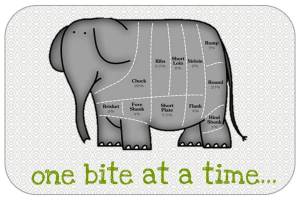
4. Eat an elephant.

How do you eat an elephant? You don’t eat them . 1578c80f0feae231b50cf1d3b641e593


Okay serious.

You eat one bite at a time. Which means, from one big goal, you break it down into smaller goals. For instance, I’m planning to finish 2 books per month, so how can I do it?
Using some maths  :

2 books = 1 month

2 books = 30 days

Hence,

1 book = 15 days.

So I can focus on finishing the current book in my hands in 15 days. Now that I already have the book I can break the book again into smaller parts to fit in the 15 days. For example :

1 book = 15 days

30 chapters = 15 days

2 chapters = 1 day.

5. Be sensible.

How do you eat an elephant in one day?

Well, unless you have a stomach with the size of a average hand luggage and a metabolism as fast as lightning, you can’t eat an elephant in one day, even though one bite at a time.

Knowing yourself and having a common sense is crucial as well.

Taking the book again as an example, if the book happens to be 1000 pages and I’m the Minister at the Ministry of Education (dream, believe, make it happen), I don’t think I’ll be able to finish it in 15 days. So it’s fine, maybe for that month I can skip the other book and make it up in the coming months, if possible.

So keeping the goal according  to our ability is equally important to avoid harms and disappointments. Keep it mind that this is not the same as not dreaming big enough. This actually means being wise. There’s a difference between pushing the limit and pushing over the limit.

6.  Discipline, discipline, discipline.

All points mentioned above will never, ever be effective without having discipline. Behind every success is the perseverance to keep going until we reach the top. More often than not we will have that one point when we are lazy and all we want to do is sleep. This is a great battle within us that we have to fight. As much as possible, don’t give in to the evil whisper. Defeat it, and keep on winning.

7. Seek for Allah’s help.

Last, but not least. In fact, this is the first thing we should do as Muslims. Allah can build the Universe, He can help us build our dream. With His great power He can make everything possible. Our fate, after all, is in His hands. Build a good and strong relationship with Him through acts of worship especially solat. Ask from Him anything you want, because He will definitely grant you. Remember Him, and He will remember you.

Hope we can benefit from this together 🙂

In The Case of A Mukmin.


Depression_2014_Types_10-22-14_5PM-img_1280x720

With every choice we make, there’s always consequences that we need to face, be it good or bad, and chances of screwing up is always present. On this road which has been promised to be thorny and bumpy, giving up is indeed the easiest decision to make. I mean, no sane human being would make a conscious choice to throw himself into the fire, right?

But in the case of a Mukmin, he knows that the fire is just an illusion, and beneath the illusion, something better is waiting. All the thorns and bumps on the path that he has chosen are nothing but what he has to go through to reach that better something at the end.

But human will always be human. We trip,  we get hurt, we break down, we screw up and sometimes, all we want to do is turn back, and take that easy road. Why bother troubling ourselves with all the pain we have to go through?

But in the case of a Mukmin, that road is the only road he can take to reach his Master in a happy state. He endures everything because all he wants is to meet his Lord with a calm heart, knowing that he will be rewarded with what has never been seen with the eyes, what has never been heard by the ears, and what has never crossed the heart.

However, there are always other elements that seem to be trying so hard to stop us from moving forward and ignoring all those things that pained us. The fear, the lost hope, the sadness, the failures and the whispers. They just keep on perturbing our mind, leaving no space for peace even for an inch.

But in the case of a Mukmin, he knows the whispers are merely trying to stop him from doing what’s right, and every single time he feels that rush of doubts flowing in, he brushes them off and said to himself,

“Not today. Not today.”

The gold in Umar.


I’m not a series person. I’m not patient enough to wait for the next episode until the next week. I’m not even patient sometimes to wait until the end! I have close friends who are big fans of the K-entertainment, so a few years back I tried to jump into the wagon by watching Boys Over Flower and the music videos of the K-Pop hits of that time and learning the dance moves, but none of these managed to make me sit still. I gave up the former after only four or five episodes.

But learning language coupled with my shyness to speak up forced me to diversify my ways of learning. Last year, when I was learning Turkish, I tried to start watching Turkish series, but anyone who has experience with Turkish series will know how even the freaking montage takes about five minutes and one episode could take up to two hours.

And now as I am nearing to my Arabic prep final and my Arabic is still not able to convince people that I actually studied Arabic, I had to resort to the same technique i.e watching series. Alhamdulillah this time it’s easier because :

  1. I can find series that don’t last for two hours
  2. It’s easy to find something that’s Syariah-compliant because really, sometimes it’s hard to find Turkish series/music video that don’t make you go Astaghfirullah every 3 minutes.

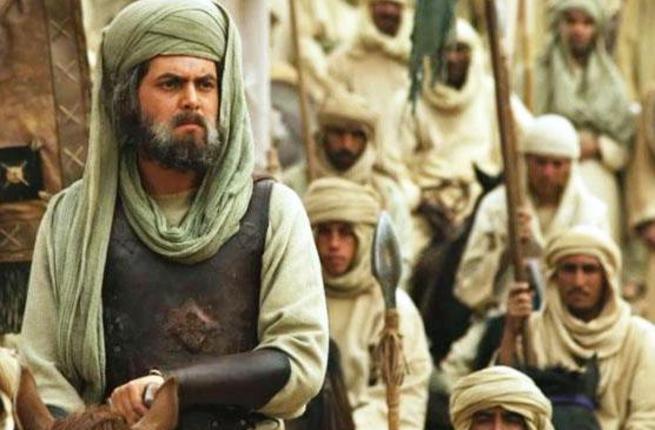
So one of the first on my to-watch list is the Omar Series.

download (2)

I’ve heard of Omar Series from my friends way before I decided to come to Turkey, but I never got the chance to watch it. Only after my Arabic course did I  make some time to see how it looks like. But this too, did not last long. I only managed to watch one episode then I got busy and completely forgot about it.

Then during my recent exam I had a bad case of anxiety. It was the second final exam before the major proficiency test this May-June, and my Arabic is still so bad. One day I was so anxious that I couldn’t study, which made me more anxious which made the mental block worse. But I gotta do something about it. Then I remembered about the series, and I came up with the decision to “study” through the series and binged- watched it that night.

What I got was not just a better understanding of some words I couldn’t use before, but also some enlightenment on the early days when Islam just started to be propragated. Finally I understood why not everyone was tortured by the Quraisy back in the days. To those who want to understand the history of early Islam better, Omar Series is definitely a recommendation.

Just as the title says, it’s a depiction of the life of Umar Al-Khattab R.A from before Islam until post-Rasulullah SAW period. The series is really good in my opinion as it gives a clearer picture of how it was and what actually happened back then. I really thought Umar was this ruthless man who would beat the cupcake out of the Muslimin, but apparently he was not that ruthless. But yes, he was tough. He joined the elderly heads of clans at Dar An-Nadwah (kind of a parliament of Quraysh clans), discussing about measures they needed to take to stop the new religion Rasulullah SAW was calling to which was ‘threatening’ them, as it was calling to many aspects that would destroy their tradition of idolatry, social class division and despicable practices that they firmly upheld.

Umar being a member of Dar An-Nadwah would mean he is the last person you’d want to see if you were to be a Muslim in the early period. The members of Dar An-Nadwah were among the most tyrannical and hostile towards the Muslim, and indeed Umar was so tyrannical that nobody had the faith that Umar would submit to Islam ever, that there was even a statement saying

“Never will Umar submit [to Islam] until his donkey submit [to Islam]”

Not sure if his donkey actually did, but we all know that Umar did embrace Islam eventually. The news of his submission created sensations among Muslims and the Quraiysh opponents, as nobody saw it coming.

After becoming Muslim, to everyone’s amazement, he became among the biggest defenders of Islam. He became one of Rasulullah SAW closest companions. His bravery put Muslims at that time into a safer position, and only after he enters Islam the Muslims were able to do their ibadah openly. He was also nicknamed Al-Faruq , meaning “he who distinguishes truth from falsehood” .  During the event of Hijrah, while most companions were leaving Makkah covertly, he went up to Kaabah and announced his migration, and challenged “those who want their wives to lose their husbands, their children to lose their parents, and their mothers grieving endlessly” to stop him.

Umar R.A is a nice example of one of the ahadith Rasulullah SAW.

From Abu Hurairah R.A, “Rasulullah SAW said : “The people are like mines of silver and gold. The best of them in ignorance are the best of them in Islam if they have understanding.””

Umar R.A was already a respected man long before he was a Muslim, but he had a dark pre-Muslim past. If the people during the Jahiliyyah period were coffee, Umar R.A would be espresso. There was one time when he was stalking Rasulullah SAW when Rasulullah SAW was praying, Rasulullah SAW was reciting Al-Haqqah. He was actually touched by the ayat, but he said (not the actual dialogue) :

“This sounds just like the Quraisyi poem”

Then the 40-41 ayat of Al-Haqqah said :

“Most surely, it is the Word brought by an honoured Apostle. And it is not the word of a poet; little it is that you believe.”

Then Umar R.A said :

“Then he must be a forecaster.”

To which, the 42nd ayat said :

“Nor it is the word of a soothsayer; little it is that you mind”

And that moment, he felt something in his heart, but the Jahiliyyah in him was too strong. He refused to let go of their Jahiliyyah traditions.

But ‘alaa kulli haal, Allah answered Rasulullah SAW’s prayer to make either of two Umars a Muslim (the other being Abu Jahal) by choosing Umar R.A. Allah granted Umar R.A understanding in Islam, and you see what happened?

That same man who were tough to Muslims before he become one became as tough to the Musyrikin as he was to Muslims after he became one of them. The qualities he had during Jahiliyyah did not diminish at all after he became Muslim, on the contrary he made use of that quality to contribute to Islam, and in the end, he is one of the significant figures who paved Islam its way to glory.

Fact is, all of us have the goodness in us that we can make use to help Islam. Allah has created us in the best form [At-Tiin : 4] and Allah has shown us the ways [Al-Balad]. Understanding is an effort, just like how we try to understand all the mathematical formulas. So we’ve got the gold. The only thing we need to work on now is the understanding. That’s what happened to Umar R.A. Already a gold himself, his value got higher as he understood what being a Muslim is all about.

Umar R.A maximised his gold and continued the legacy of Rasulullah SAW until the end of his life.

Have you found your gold yet? 🙂