I’m not a series person. I’m not patient enough to wait for the next episode until the next week. I’m not even patient sometimes to wait until the end! I have close friends who are big fans of the K-entertainment, so a few years back I tried to jump into the wagon by watching Boys Over Flower and the music videos of the K-Pop hits of that time and learning the dance moves, but none of these managed to make me sit still. I gave up the former after only four or five episodes.
But learning language coupled with my shyness to speak up forced me to diversify my ways of learning. Last year, when I was learning Turkish, I tried to start watching Turkish series, but anyone who has experience with Turkish series will know how even the freaking montage takes about five minutes and one episode could take up to two hours.
And now as I am nearing to my Arabic prep final and my Arabic is still not able to convince people that I actually studied Arabic, I had to resort to the same technique i.e watching series. Alhamdulillah this time it’s easier because :
- I can find series that don’t last for two hours
- It’s easy to find something that’s Syariah-compliant because really, sometimes it’s hard to find Turkish series/music video that don’t make you go Astaghfirullah every 3 minutes.
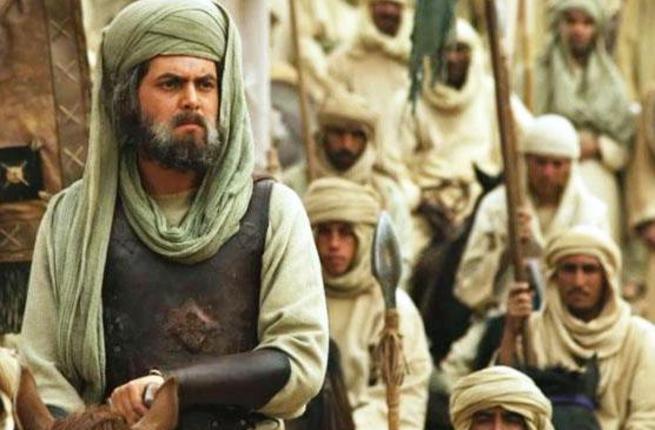
So one of the first on my to-watch list is the Omar Series.

I’ve heard of Omar Series from my friends way before I decided to come to Turkey, but I never got the chance to watch it. Only after my Arabic course did I make some time to see how it looks like. But this too, did not last long. I only managed to watch one episode then I got busy and completely forgot about it.
Then during my recent exam I had a bad case of anxiety. It was the second final exam before the major proficiency test this May-June, and my Arabic is still so bad. One day I was so anxious that I couldn’t study, which made me more anxious which made the mental block worse. But I gotta do something about it. Then I remembered about the series, and I came up with the decision to “study” through the series and binged- watched it that night.
What I got was not just a better understanding of some words I couldn’t use before, but also some enlightenment on the early days when Islam just started to be propragated. Finally I understood why not everyone was tortured by the Quraisy back in the days. To those who want to understand the history of early Islam better, Omar Series is definitely a recommendation.
Just as the title says, it’s a depiction of the life of Umar Al-Khattab R.A from before Islam until post-Rasulullah SAW period. The series is really good in my opinion as it gives a clearer picture of how it was and what actually happened back then. I really thought Umar was this ruthless man who would beat the cupcake out of the Muslimin, but apparently he was not that ruthless. But yes, he was tough. He joined the elderly heads of clans at Dar An-Nadwah (kind of a parliament of Quraysh clans), discussing about measures they needed to take to stop the new religion Rasulullah SAW was calling to which was ‘threatening’ them, as it was calling to many aspects that would destroy their tradition of idolatry, social class division and despicable practices that they firmly upheld.
Umar being a member of Dar An-Nadwah would mean he is the last person you’d want to see if you were to be a Muslim in the early period. The members of Dar An-Nadwah were among the most tyrannical and hostile towards the Muslim, and indeed Umar was so tyrannical that nobody had the faith that Umar would submit to Islam ever, that there was even a statement saying
“Never will Umar submit [to Islam] until his donkey submit [to Islam]”
Not sure if his donkey actually did, but we all know that Umar did embrace Islam eventually. The news of his submission created sensations among Muslims and the Quraiysh opponents, as nobody saw it coming.
After becoming Muslim, to everyone’s amazement, he became among the biggest defenders of Islam. He became one of Rasulullah SAW closest companions. His bravery put Muslims at that time into a safer position, and only after he enters Islam the Muslims were able to do their ibadah openly. He was also nicknamed Al-Faruq , meaning “he who distinguishes truth from falsehood” . During the event of Hijrah, while most companions were leaving Makkah covertly, he went up to Kaabah and announced his migration, and challenged “those who want their wives to lose their husbands, their children to lose their parents, and their mothers grieving endlessly” to stop him.
Umar R.A is a nice example of one of the ahadith Rasulullah SAW.
From Abu Hurairah R.A, “Rasulullah SAW said : “The people are like mines of silver and gold. The best of them in ignorance are the best of them in Islam if they have understanding.””
Umar R.A was already a respected man long before he was a Muslim, but he had a dark pre-Muslim past. If the people during the Jahiliyyah period were coffee, Umar R.A would be espresso. There was one time when he was stalking Rasulullah SAW when Rasulullah SAW was praying, Rasulullah SAW was reciting Al-Haqqah. He was actually touched by the ayat, but he said (not the actual dialogue) :
“This sounds just like the Quraisyi poem”
Then the 40-41 ayat of Al-Haqqah said :
“Most surely, it is the Word brought by an honoured Apostle. And it is not the word of a poet; little it is that you believe.”
Then Umar R.A said :
“Then he must be a forecaster.”
To which, the 42nd ayat said :
“Nor it is the word of a soothsayer; little it is that you mind”
And that moment, he felt something in his heart, but the Jahiliyyah in him was too strong. He refused to let go of their Jahiliyyah traditions.
But ‘alaa kulli haal, Allah answered Rasulullah SAW’s prayer to make either of two Umars a Muslim (the other being Abu Jahal) by choosing Umar R.A. Allah granted Umar R.A understanding in Islam, and you see what happened?
That same man who were tough to Muslims before he become one became as tough to the Musyrikin as he was to Muslims after he became one of them. The qualities he had during Jahiliyyah did not diminish at all after he became Muslim, on the contrary he made use of that quality to contribute to Islam, and in the end, he is one of the significant figures who paved Islam its way to glory.
Fact is, all of us have the goodness in us that we can make use to help Islam. Allah has created us in the best form [At-Tiin : 4] and Allah has shown us the ways [Al-Balad]. Understanding is an effort, just like how we try to understand all the mathematical formulas. So we’ve got the gold. The only thing we need to work on now is the understanding. That’s what happened to Umar R.A. Already a gold himself, his value got higher as he understood what being a Muslim is all about.
Umar R.A maximised his gold and continued the legacy of Rasulullah SAW until the end of his life.
Have you found your gold yet? 🙂
 Thoughts In Pieces