I’ll be hitting the big 2-0 this year. Yeay, I’m legal again. I’m sure I’m getting to the legal age somewhere in another part of the world haha. So, quite normally, a question arise when some friends are nearing to their new age.
“What have I done for the ummah?” Well, actually we ask ourselves this question quite often.
And one quite common question also,
“Sultan [Muhammad] Al-Fatih umur 21 sudah menakluk Constantinople. Aku apa dah ku buat?”
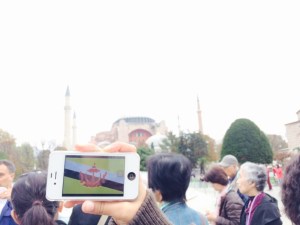
My first Ayasofya shot #proudbruneian #generasiberwawasan
Honestly, I’m no different. I have been asking myself the same question not too long after i turned 17. So that’s almost 3 years ago and, if i took Al-Fatih’s achievements as my benchmark a bit seriously, I’d have one more year to go. But I don’t wanna get into trouble for vandalising the remnants of the Wall of Constantinople.
Okay i kid.
Let’s take a stroll down the memory lane shall we?
Istanbul was previously known as Byzantium before Emperor Constantine the Great made it as the capital of East Roman Empire, which led to it being named Constantinople. Although the ‘Uthmaniyyah Caliphate besieged the city in 1453, attempts had been made since the time of the Umayyad Caliphate.
While the Muslim attempts to capture Constantinople were motivated by the prophetic revelation of Rasulullah SAW, other foreign powers were also trying to seize the city due to it’s strategic location. But the wall was unbreakable. None of the numerous attempts managed to pass the fortress with victory.
However, finally, the epiphany of Constantinople being captured by the best leader with the best army was proven with the success of Sultan Al-Fatih entering the city after quite a challenging journey, mentally and physically, at the mere age of 21.
His success at such a young age can be a motivation for us youngsters who most of the time do nothing except lazing around to get up and do something for the world.
The story of Feth-i Istanbul as we call it here, together with the fact that it was a job of a brave young man is quite a pride for the Muslims (tho we have not much to be proud of anymore).
A recent tazkirah session with some friends however showed me another perspective on the story. Remember that Al-Fatih’s attempt is not the first one and the Umayyad Caliphate made the first move, 8 centuries before them? And even during the ‘Uthmaniyyah time attempts had been made since the previous sultans.
So the Siege of Constantinople is not a one-time event, but it was a series of attempts made by generations of Muslims who were holding the power at the time. And it all started with the first Arab Siege of Constantinople. In the campaign, there was one important figure that we tend to overlook.
He was Abu Ayyub Al-Ansory.
He was the lucky sahabah whom Allah had chosen to receive Rasulullah SAW as his guest during the Hijrah to Yathrib, now known as Madinah (Al-Munawwarah TEEHEE). Rasulullah SAW stayed with him for a few months while the Masjid An-Nabawi was being constructed in front of Abu Ayyub’s house. So, after the construction was done, they remained neighbours.
Can you imagine how old he was during the Umayyad Caliphate? Yes, very. He lived through the time of Rasulullah, Khulafaa Ar-Rasyideen and the Muawiyah I of the Umayyad Caliphate. However, that did not stop him from joining the campaign. In fact, he never missed any war campaign in the early Islamic history except for when he was on another mission.
He could opt to stay and retire from joining war with that age, but he didn’t. Constantinople being set free from the hands of the Eastern Roman Empire was a promise of Allah that every Muslim at that time was looking forward to. Abu Ayyub wanted to see for himself the victory that Allah had promised. How impressive it is that his spirit did not age with his body.
He, however, did not get to see Constantinople being conquered. He fell ill during the campaign and requested to be buried to the nearest point the army could reach to the Wall of Constantinople after his passing, so he “could hear the sound of the footsteps of the horses of the army who would liberate the city”. His grave had been developed into a mausoleum and a masjid was built nearby by Sultan Al-Fatih right after his victory, making it the first masjid built after the Fall of Constantinople and it was named Eyup Camii.
You see, there are so many ibrah (lessons) that we can get from this epic story of success. When we see the bigger picture we will see the tiny,tiny details formed together that make the picture beautiful. What appeals to me the most is the fact that age is indeed just a number.
Al-Fatih’s young age did not stop him from realising the dream that rooted back to the first Daulah Islamiyyah, just like Abu Ayyub’s old age did not stop him from participating in realising the dream that he witnessed being promised to happen. They both could use their age as being “too young” in the case of Al-Fatih or “too old” in the case of Abu Ayyub, but they didn’t. All they had in themselves was determination to just make it happen, by hook or by crook, win or lose, dead or alive.
No matter how old we are now, what matters the most is the desire to make a change and the effort in working towards it. It’s never too early and it’s never too late. Creating a tomorrow requires a work today. It’s okay if you have passed your 21st year of life, and it’s still okay if you have passed your 80th year. But of course it’s better if you haven’t. The goal is to create a change to the world, whether or not you are 21.
“The best of people are those that bring most benefit to the rest of mankind.”
-Rasulullah SAW-
May Allah ease your affairs 🙂


 Thoughts In Pieces